
Thanks, Help, Love: The Surprising Power of a Simple Pre-Meal Practice
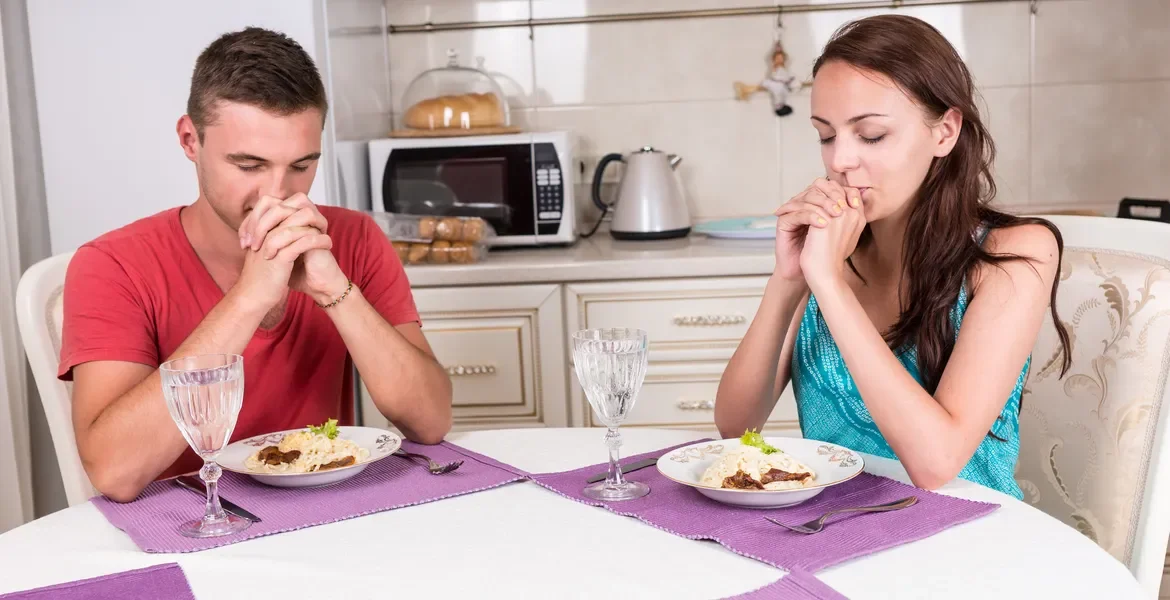
Transform awkward grace into a daily practice of sharing gratitude, holding others in compassion, and affirming love in a meaningful pre-meal ritual.
Prayers before meals can be awkward. If you haven’t experienced this personally, maybe you’ve witnessed it in movies. In the classic National Lampoon’s Christmas Vacation, Aunt Bethany is asked to say “the blessing,” and she proceeds to stand and lead the family in the Pledge of Allegiance. Or there’s the irreverent but sincere prayer given by Ricky Bobby in Talladega Nights; his pre-meal grace is directed to “Dear Lord Baby Jesus.” My favorite is probably the prayer given by Greg Focker in Meet the Parents, in which he thanks the “sweet Lord of Hosts” for the “smorgasbord” on the table, followed by lyrics of “Day by Day” from Godspell that he had recently heard playing in the supermarket.
Many people consider pre-meal prayers as a special, even sacred, practice. Some of us have memories of a beloved grandparent seated at the head of the table offering a heartfelt prayer before a holiday meal. It can also be an opportunity for kids to practice praying publicly; hearing a little one reciting a prayer touches our hearts and sometimes tickles us when “kids pray the darndest things.” I’ve also appreciated “Quaker grace,” in which we pause for a holy hush before a meal. The pre-meal pause can help us give thanks for divine goodness, acknowledge the work of many hands, and cultivate a posture of mindfulness while eating.
Developing a Pre-Meal Practice
When my wife and I got married and began to form our own family practices, pre-meal pauses were often awkward. Sometimes one of us would say a verbal prayer, but more often than not we would dig right in. We grew up praying before meals and appreciated that practice, but we also knew those prayers could become less meaningful after so much repetition.
Eventually, we settled on a simple ritual that incorporates the spirit of a pre-meal pause without relying on rote prayers or awkward blessings. I like to call it our “Thanks, Help, Love” practice. It sounds a bit like a combination of Elizabeth Gilbert’s Eat, Pray, Love and Anne Lammot’s Help, Thanks, Wow, but that’s a happy accident and not intentional.
Thanks: What Are We Grateful For Today?
We begin by sitting down at the table before our full plates and naming something or someone for which we are grateful. Maybe a work meeting went smoothly, we received kind words from a friend, or our partner did something especially nice for us. It can also be an opportunity to share an encouraging “thank you” to one another, if we appreciated something our spouse did that day. It can be anything that helps redirect our attention from what’s negative and absent to what’s positive and present. This simple practice of expressing gratitude is surprisingly powerful. It often shifts my mood in a matter of moments. It reminds me that good and God are at work in my day, even if I failed to notice in the moment.
Hearing gratitude from one’s partner provides a glimpse into their day and maybe even a window into their heart. Their thanksgiving reflects their “love language” and reveals words or actions they find most helpful and meaningful.
We often end up sharing multiple gratitudes. The process of reflecting on the positive and hearing someone else verbalize their gratitude unlocks greater awareness of previously unnoticed graces in our day.
Help: How Are We Called to Be Helpful?
After we have shared our gratitudes, we ask “Who are we holding in the Light?” I’ve written about this Quaker practice of “holding in the Light," but it is a Quaker prayer practice in which we hold someone in our heart and listen for how we could respond with compassion: We could carry them in prayer, send them a text or encouraging note, offer practical assistance, or something else. In essence, we are asking God for help and contemplating how we are called to be helpful.
Together, we individually search our hearts and identify a particular person or situation that is concerning us that day. Sometimes we will choose one specific person or situation to hold in the Light. It may only be for a few moments, but this simple practice opens up our hearts for the rest of the day.
Naming a person and holding them in the Light keeps us connected to our beloved community and centered in the Source of all compassion
Love: A Divine Commandment
Having shared our gratitudes and held our concerns, we have now delivered our version of pre-meal grace. We are ready to say “Amen,” though we don’t use that word. Instead, we use this moment to confirm our love for one another, choosing to end our prayer by saying “I love you” and “I love you, too.” It’s unconventional and may come across as a little cutesy; some may suggest it’s not particularly spiritual. But I disagree. My Quaker faith teaches me that God is love and all of life can be sacramental—a means of experiencing God’s transforming love. Jesus teaches me that the most important commandments are love of God and neighbor. Speaking words of love for our partner or family is a good way to start living that teaching (even and especially if we are having a quarrel that day).
Simple and Powerful
This entire process typically takes us only three to five minutes. Of course, the pre-meal ritual can be drawn out and savored as long as one wishes. (We have never had an issue with the food getting cold, but if that’s a concern, put your mind at ease by doing the practice before the food is plated.)
Despite being a short and simple practice, it is probably the most meaningful spiritual practice my wife and I do together and the one that has had the most impact in my own life. It is also the one we practice most consistently. By “habit-stacking” this practice with regular mealtimes, we are free from the stress of finding time to squeeze in a spiritual discipline and the guilt we feel when we forget. We eat every day, so it’s a built-in spiritual practice.
The average person eats tens of thousands of meals in their lifetime. Imagine how our lives and communities could be different if we used those daily pauses to put a little more gratitude, compassion, and love into the world. At the very least, this practice could make a positive impact in our own hearts and households. But I believe the after effects of this pre-meal practice rippling out into the wider world could be greater than we imagine. Every day, in the course of only a few minutes, we could nurture gratitude, awaken compassion, and affirm love.
by Andy Stanton-Henry
