
Do Animals Dream?
Animal Wisdom Collection
Many animals share similar brain structures to humans that regulate dreaming, but what they actually experience within their dreams remains unknown.
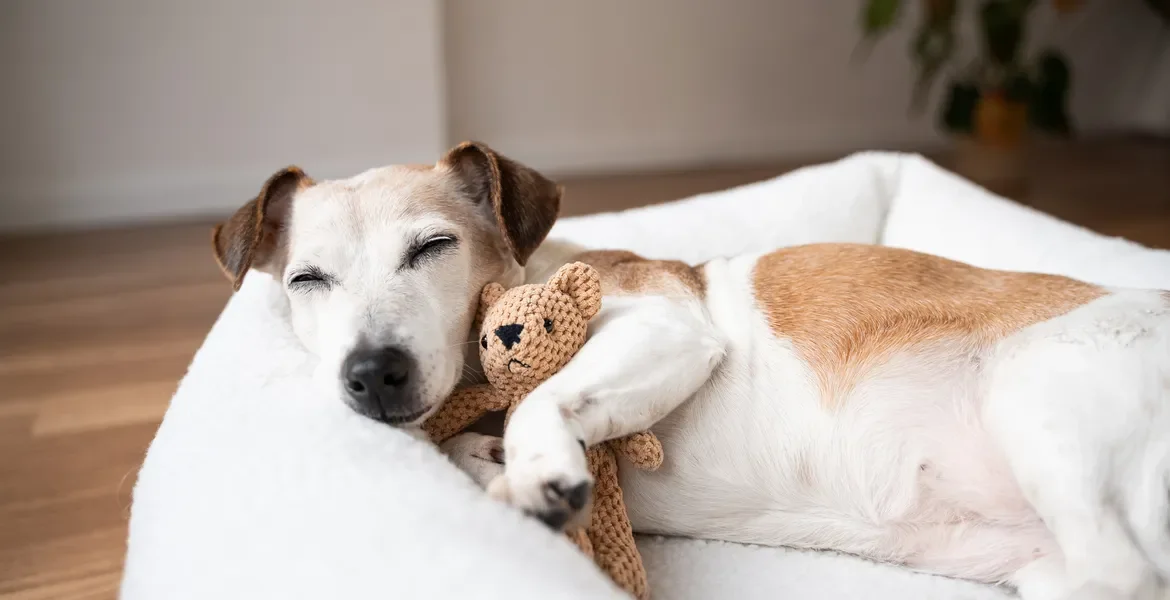
Streeeetttccchhhh go the feet of my feline housemate, Deacon. Generally skittish and quick to jump off the sofa when my husband or I sneeze, the cat now stretches out on the sofa, his body twice as long as I am used to seeing it. He falls asleep. Deacon’s paws twitch back and forth, and I can’t help but wonder just what is going on in his dream life.
If you live with an animal companion, you’ve probably seen a moment like this too. A flick of the ears. Legs running in place. Many of us instinctively assume that our animals dream, and it’s hard not to ponder what they dream of: Is he chasing a squirrel? Bounding through a field? Gulping down a seemingly endless bowl of his favorite food?
Scientific inquiry supports this assumption. For example, in one well-known set of experiments, rats who ran mazes during the day showed similar neural firing patterns while asleep, as though “replaying” their experiences. Over the last 30 years, studies have stacked up to suggest animals do something equivalent to or similar to dreaming.
The methods of some of these research projects get my ethical hackles up. In contrast to studies on human sleep that rely on verbal self-reports offering vivid explanations of our dream lives to researchers, animal dream research often impedes animal lives, keeping them caged and under observation. Do rat paws running during sleep mean they dream of breaking free from the lab? It seems possible.
However, we must acknowledge that knowing what an animal is dreaming of is beyond our knowledge. Nevertheless, the capacity for dreaming across a wide array of taxa is compelling, challenging the often-held belief that animals are somehow always in the present moment. While that notion has been disproven repeatedly, perhaps the presence of dreaming can add yet another nail to its coffin.
In their 2021 study, Manger and Siegel explain that the capacity for dreaming may be far more widespread across mammals than we tend to assume, pointing to shared neurobiological structures across species. Looking at a wide range of creatures—from rodents and primates to cats and dogs—these researchers argue that many mammals exhibit the same kinds of sleep architecture, particularly REM sleep, that in humans is closely associated with dreaming.
Rather than asking whether animals dream like us, though, the researchers suggest a reframing: If the brain mechanisms that support dreaming in human beings are present, then some form of dream experience is likely in animals who also have those mechanisms, even if their experiences are not relayed to us narratively or linguistically.
Dreaming serves crucial biological functions. If dreams help our minds by weaving meaning from the day, processing encounters, integrating emotions, and pondering future possibilities, then it seems almost strange not to imagine animals dreaming too. After all, they also navigate relationships, remember places they’ve been, anticipate outcomes of situations, experience fears, and engage in playful moments. Why wouldn’t their sleep time carry some echo of those experiences? When a bear hibernates, does she replay an entire season? Or dream of what will happen when she emerges from sleep?
The Private Lives of Animals
Researchers acknowledge the limits of what we can know. Without direct access to an animal’s own experience, we are left to interpret their physiology and behavior. This requires us to approach dreaming with both curiosity and humility. Using human capacity for dreaming as our reference point may cause us to overlook the unique textures of each species’ process of dreaming. Does a cat dream the same way an octopus does? Probably not, since their nervous systems—and the worlds they move through—are so fundamentally different.
So the question of animal dreaming necessarily becomes less about proving equivalence between human and animal dreams or between species. Instead, the question creates an invitation to consider that we may not be as different as we think we are. We have long been a species that has regarded the interior life—imagination, reflection, dreaming—as uniquely human territory. To acknowledge animal dreams is to acknowledge their capacities. Not just their “instincts,” but their rich experiences.
Even in our homes, even in our care, there are hours where they have experiences we cannot access. I think of how often I look at Deacon or Bubba-ji and think aloud, “What is going on for you?” These moments remind me that interspecies relationships do not include total knowing. As much as I might think I understand my animal companions, they remain fascinating to me. What is going on in those minds?
Maybe Animals Daydream Too
In his 2022 book, When Animals Dream: The Hidden World of Animal Consciousness, philosopher David M. Peña-Guzmán uses dreaming as a foundation on which to theorize the need for a “zoological theory of imagination” that includes not only animal dreams but also “other imaginative acts, especially hallucinations, playful pretense, and daydreams.”
In animal chaplaincy, we often talk about honoring mystery—the part of another being that remains just beyond our grasp. Acknowledging the imaginations of other creatures can help us remember that their lives are not merely extensions of ours, but worlds that exist fully without us. Our cats and dogs may be dreaming about chasing birds and squirrels, but perhaps their sleep musings are much more profound than we could ever imagine.
by Sarah Bowen
