
A 7-Step Loving-Kindness Meditation for Climate Anxiety
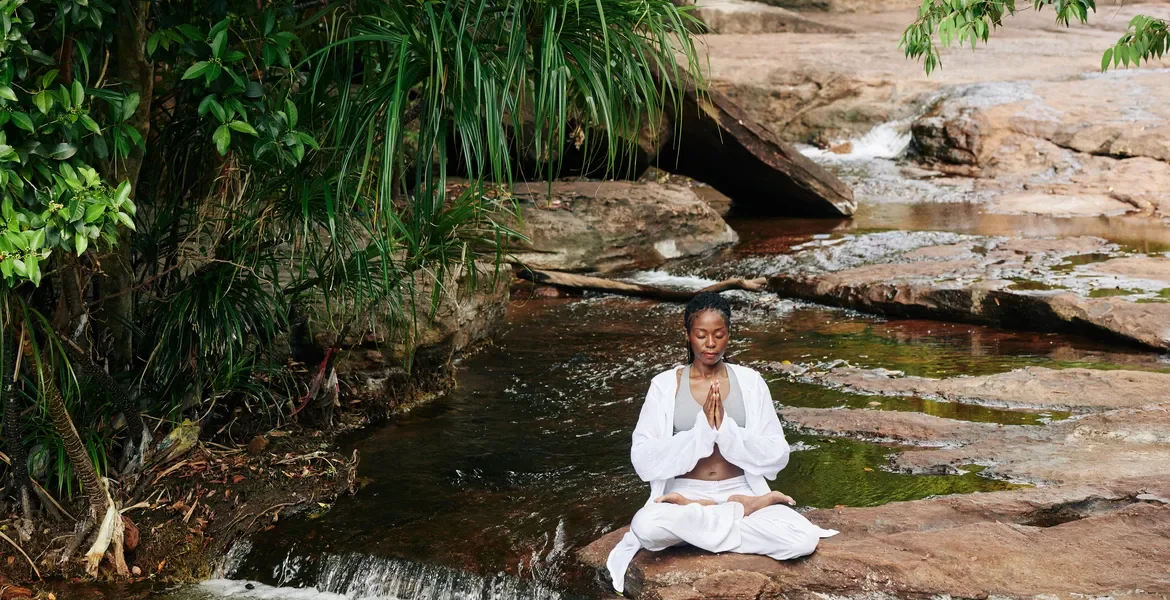
When climate anxiety feels overwhelming, a simple loving-kindness meditation can help. Drawing on a traditional Buddhist practice, this 7-step guide offers a way to move from fear toward greater calm, compassion, and clearer action in a warming world.
I thought I was safe from climate change. Watching the news, I’d see wildfires, droughts, and floods happening all over the world. But where I live in Nova Scotia, everything seemed fine.
Until it wasn’t.
In the summer of 2023, we were hit with a one-two punch: the most devasting wildfire season on record and the most intense rainfall of my lifetime, which resulted in severe flooding.
The fire came first. One afternoon, there arrived the smell of smoke in the air, a smudge on the horizon, and a smattering of burnt fir needles on my veranda carried there by the wind. I thought the firefighters would get the blaze under control that same day or the next. But they didn’t. They couldn’t.
My husband showed me a map. “Here’s where our place is,” he said. “Here’s where the fire started, and here’s where it is now.” The fire had already burned an area bigger than the distance between our house and the current fire front.
I started to pack boxes in case we had to evacuate suddenly. I packed dishes that had belonged to my grandmother, books I’d inherited from my father. Soon, I realized my car couldn’t hold all the things that meant something to me.
Eventually, the fire was put out. I was relieved my home was still standing, but I was also aware that thousands of people no longer had their homes, their mementos. On the news, experts weighed in: This fire wasn’t a one-off. With climate change, Nova Scotia would have more climate-related disasters. The subsequent flooding, which also spared our home, bore out their predictions.
The illusion that I was safe from climate change fell away. I saw the truth: None of us, no matter where we live, are safe from a warming world. Maybe I’m unscathed this time, but it doesn’t mean I will be next time. Thinking about my kids—and everyone’s kids—climate anxiety gripped me, tight in my chest.
The Roots of Loving-Kindness
A few years have gone by since that summer of fire and flood. While I’m still concerned about rising temperatures, I’ve learned how to manage my climate anxiety—not so I can bury real concerns but so I can take more effective action.
I’ve discovered loving-kindness meditation is a simple practice from the Buddhist tradition that can help anyone who is worried about our world find some relief.
Tradition has it that loving-kindness meditation was taught by the Buddha. A group of monks went to a forest to meditate, failing to notice that it was inhabited by tree spirits. These spirits wanted the forest all to themselves, so they began trying to scare off the monks with disturbing sounds, smells, and visions.
It worked. The monks hightailed it out of there.
“Go back,” the Buddha gently suggested. “But this time, protect yourself with armor.”
The monks were dubious. “What armor can protect us from spirits?” they asked.
“Loving-kindness,” he answered.
What the Buddha meant was that they should offer affirmations of friendliness to all beings in the forest—without exception, no matter what they looked like or what they were doing.
So, that’s what the monks did. They sat under the trees, cultivating love for everyone. In time, the tree spirits were soothed. They stopped their haunting and supported the monks instead.
A Meditation for Climate Anxiety
What does this ancient story have to do with climate change?
For both the monks and for us—albeit in different ways—nature is proving to be terrifying. Yet loving-kindness has the power to transform our fears. Its power isn’t supernatural. When we practice this meditation, we’re not magically healing or protecting all beings; we’re transforming our own state of mind. Fostering goodwill, we find ourselves feeling calmer and more open. And from that space, we’re in a better position to take wise and compassionate action to address global warming.
What follows are step-by-step instructions for loving-kindness meditation when experiencing climate anxiety.
1. Preparation
If possible, find a safe, quiet place to practice, such as your bedroom or a garden. If you’re in the midst of a climate disaster, that kind of space may not be accessible to you. That’s all right—the practice is always available. Just close your eyes and imagine yourself somewhere peaceful. You can be sitting, standing, or lying down—whatever feels comfortable. Notice what part(s) of your body are in contact with the floor, chair, or bed. Notice how this contact feels, how it grounds you. Take at least a few breaths.
2. Extend Loving-Kindness to Yourself
Extending loving-kindness to all beings begins with you. After all, how can you help others if you yourself are not replenished? With this first step of the meditation, you nourish yourself, taking good care of your own fear and pain. Either silently or out loud, say to yourself, May I be safe. May I be free from fear. May I be at ease. If you wish, place your hands on your cheeks or chest. Repeat these phrases as many times as you like, letting the meaning sink in.
3. Extend Loving-Kindness to a Loved One
Bring to mind someone you care for deeply. This could be a family member, friend, or pet. Let your warm feelings for your loved one wash over you, and then recite the affirmations for them: May you be safe. May you be free from fear. May you be at ease. Repeat as desired. This should feel good.
4. Extend Loving-Kindness to a Neutral Person
A neutral person is someone you don’t know well, perhaps a stranger. It could be a neighbor whose name you don’t know or a waiter at a restaurant you sometimes go to. Bring this person to mind and think about how they want safety and happiness just as you do. Now, as many times as you like, recite the affirmations for them: May you be safe. May you be free from fear. May you be at ease.
5. Extend Loving-Kindness to a Difficult Person
A difficult person might be your uncle who’s a climate denier, or a politician or CEO whose actions are exacerbating climate change. Contemplate how this person, just like you, wants to be happy and safe, even if they’re trying to achieve happiness and safety in an unskillful way. Recite the affirmations for them: May you be safe. May you be free from fear. May you be at ease. The purpose here isn’t to cultivate goodwill for this difficult person so that you’ll allow them to do harm. The purpose, rather, is to learn how not to let someone else’s behavior dominate your inner life, reducing fear and reactive behavior.
6. Extend Loving-Kindness to All Beings
Think of the whole interconnected web of life on this blue dot of a planet—all the people, animals, plants, fungi, bacteria. Holding your warm, loving feelings for all these beings in your heart-mind, repeat the affirmations: May you be safe. May you be free from fear. May you be at ease.
7. Take Your Practice into the World
The end of the practice is never the end. You can practice this meditation again and again to grow your muscle of loving-kindness. And it’s not as if this practice is all you need to do. How can you take steps to protect yourself and others from the risks of climate change? Armed with goodwill, you’ll see clearly what action to take to make an impact on the world.
by Andrea Miller
